

The Norwood Scale Explained: What Stage Is Your Hair Loss? (And What to Do at Each Stage)
Understand the 7 stages of the Norwood scale, the classification system doctors use for male pattern hair loss, and what treatment options...
Read →
Androgenetic alopecia (AGA), more commonly known as male pattern baldness, is the leading cause of hair loss in men. It affects around half of all men by the age of 50, and develops gradually over time due to a combination of genetics and hormones.

Both hormones and genetics play a large role. Some men may lose their hair before the age of 25 while others may keep a full head of hair without ever needing treatment.
People who are susceptible have increased levels of the male hormone dihydrotestosterone (DHT) in their scalp. This hormone causes changes in their hair cycle, reducing the growth (anagen) phase such that the follicles gradually shrink (known as miniaturisation). Shrunken follicles produce hairs that are shorter, finer and lighter, and some eventually stop producing visible hair altogether. Lifestyle factors such as stress, smoking and diet may also speed up hair loss, although genetics and hormones remain the main drivers.

Male pattern hair loss typically begins with thinning at the crown of the head and a thinning or receding at the temples. Without treatment, the hairline will continue to recede and the hair on the top of the head will become thin and sparse.
Hair loss will happen slightly differently for everyone, although the symptoms are usually easily identifiable. For some people it will be very gradual over many decades, while others can notice it over the space of a couple of years.
It usually displays in one or both of the following ways.
The Norwood-Hamilton scale is the standard medical system used to measure and classify the progression of male pattern baldness (androgenetic alopecia). The stages are illustrated and described below.
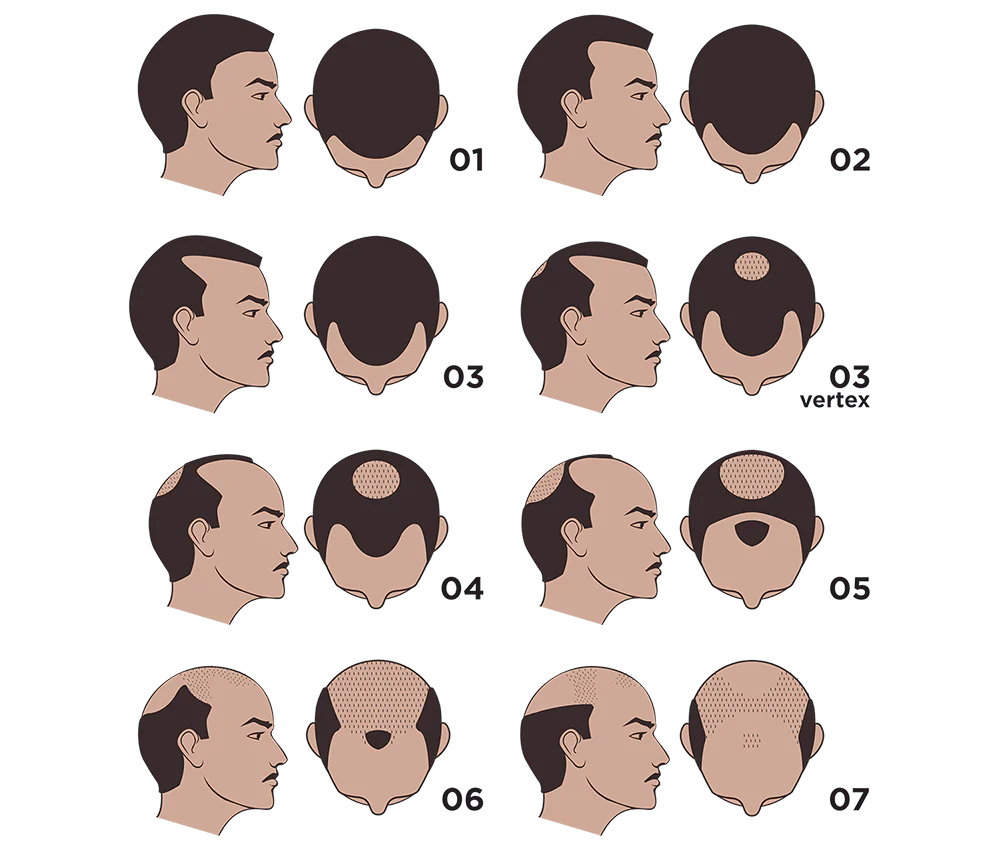
There are many other causes of hair-loss, which typically don’t present with the same gradual patterrn, some of which are listed below. These conditions won’t typically respond to the medications used to treat male pattern baldness and your doctor will screen for these in your first consultation. More than one cause can be present at the same time. Male pattern hair loss can occur together with other types of hair loss.

Hair shedding caused by a stressful experience or trauma. This usually occurs all over the scalp
Read moreRead lessTriggers may include illness, surgery, major stress, rapid weight loss, unusual diets and some medicines. Normally only a small share of hairs are in the resting (telogen) phase at any time. A shock to the body can push many more hairs into that resting phase at once, and they fall out together around 2 to 3 months later. That delay is why the shedding often seems to come out of nowhere.
It usually shows up as more hair than normal on the pillow, in the shower or on a brush, with thinning spread evenly over the scalp rather than at the temples or crown like for male pattern baldness. The hair follicles aren’t damaged, so once the trigger has passed, the hair typically grows back and the shedding settles over 6 to 9 months. If shedding goes on for longer than 6 months, or it starts to look patterned, it’s worth seeing a doctor, as it can sometimes sit alongside male pattern baldness or point to an ongoing cause such as low iron or a thyroid problem.

Nutrient deficiencies such as low iron and thyroid disorders can contribute to shedding.
Read moreRead lessHair growth needs a steady supply of nutrients and normal hormone levels. Low iron stores, an underactive or overactive thyroid, and other conditions can all tip more hairs into shedding. Like stress shedding, this usually looks like general thinning over the whole scalp rather than a pattern.
There are often other clues, such as tiredness, feeling cold or hot and weight changes. A doctor can check these with a blood test. When the underlying problem is treated, the shedding usually improves. Taking supplements without a test isn’t recommended.

An autoimmune condition that causes patchy bald spots, with an unpredictable course.
Read moreRead lessIn alopecia areata, the immune system attacks the hair follicles causing round or oval patches of hair loss, often smooth and appearing quite suddenly. It can affect the scalp, beard, eyebrows or body hair. The follicles aren’t destroyed, so regrowth can occur.
It’s a different condition from male pattern baldness and is treated differently, so the treatments used for male pattern baldness aren’t appropriate. If you notice distinct bald patches rather than gradual thinning, it's best to see a GP or dermatologist in person.

Problems such as dandruff, psoriasis or a fungal infection of the scalp can cause hair loss.
Read moreRead lessAn inflamed or infected scalp can cause hair to break or shed. Signs include flaking, redness, itchiness, scaly patches or soreness of the skin.
A fungal infection (such as tinea capitis) can also cause patchy hair loss with broken hairs and requires antifungal treatment.
Many scalp conditions settle with the right treatment, after which the hair usually recovers. For these conditions, it's best that a doctor looks at your hair in person.
Understand the 7 stages of the Norwood scale, the classification system doctors use for male pattern hair loss, and what treatment options...
Read →The hairline is often the most stubborn area to treat. Here's a realistic, evidence-based answer to whether it can actually be regrown,...
Read →Medically reviewed by Dr Mahalia Theau, AHPRA registered doctor. Last reviewed November 2026. Hair thinning and shedding affect...
Read →Medically reviewed by Dr Mahalia Theau, AHPRA registered doctor. Last reviewed November 2026. When we talk about tackling...
Read →Medically reviewed by Dr Mahalia Theau, AHPRA registered doctor. Last reviewed November 2026. Many men will experience pattern...
Read →


